What No One Tells You About Consistency
May 12, 2025You've heard it all before.
"You just need to be more consistent."
But what so many well-meaning strategies fail to acknowledge is that consistency doesn't feel safe when your nervous system is constantly swinging between overdrive and shutdown.
If you've ever felt like you're doing everything right and still can't follow through - if your success comes in intense bursts followed by emotional crashes - it's not because you're lazy. It's not because you're unmotivated.
It's because your internal systems are running in survival mode.
If you've spent years wondering why you can stay consistent for a few days and then suddenly lose momentum, you're not alone. ADHD consistency isn't about finding the perfect planner or routine. It's about understanding how your brain responds to stress, overwhelm, and recovery.
What Inconsistency Actually Feels Like
Maybe this sounds familiar.
You have one really productive day, and you think, Finally. I figured it out. You answer emails, clean the kitchen, make appointments, meal prep, and even start that project you've been avoiding.
Then the next day, you can't get yourself to do any of it. The laundry feels impossible. The email you answered in two minutes yesterday now sits unread for three days. You stare at your to-do list, heart racing, unsure where to start, so you scroll instead. You try to "just do the next right thing," but it's like your brain short-circuits when too many tabs are open.
By the end of the week, you're exhausted, not just from everything you did, but from carrying around the guilt of everything you didn't.
You keep thinking, "What happened to me?"
The truth is, nothing "happened." Your brain didn't suddenly become lazy overnight. You simply hit the edge of your current capacity. Instead of seeing that as information, your brain interprets it as failure, and that's where the shame starts.
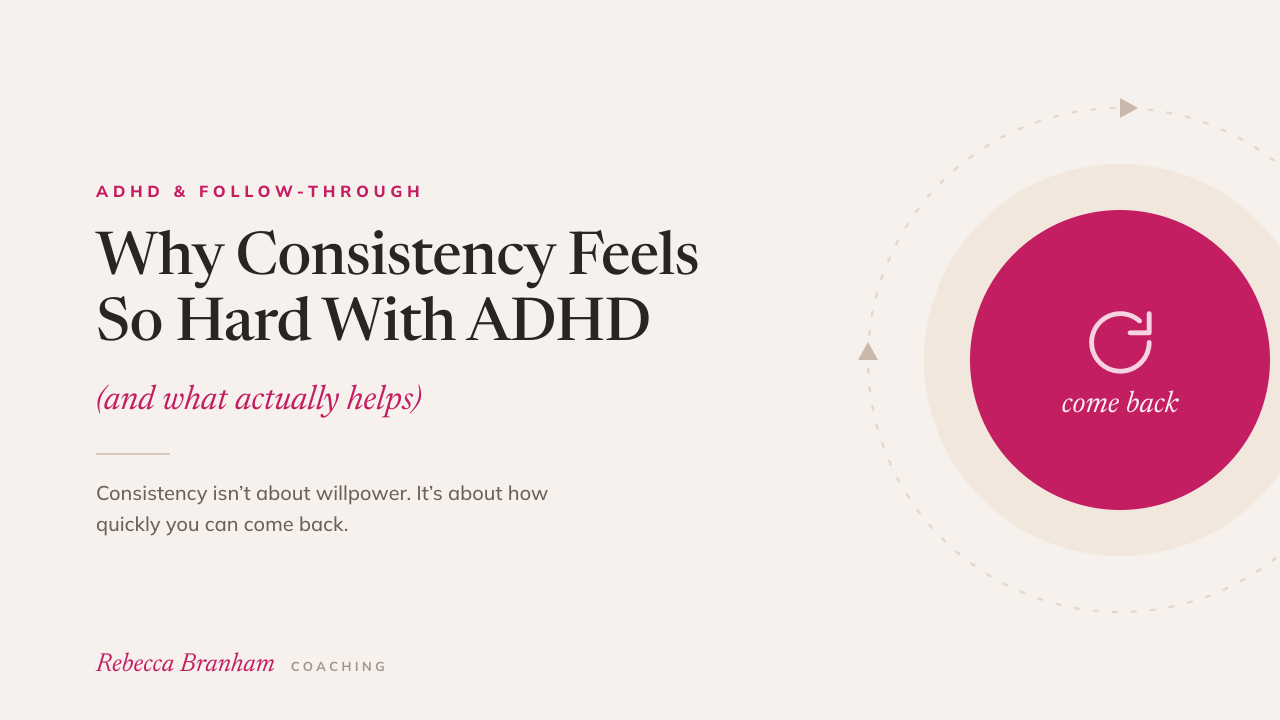
ADHD consistency isn't about how well you perform. It's about how quickly and safely you can recover.
If you've ever found yourself promising to "start over Monday," you might also like How to Get Back on Track After a Hard Week (Without Starting Over).
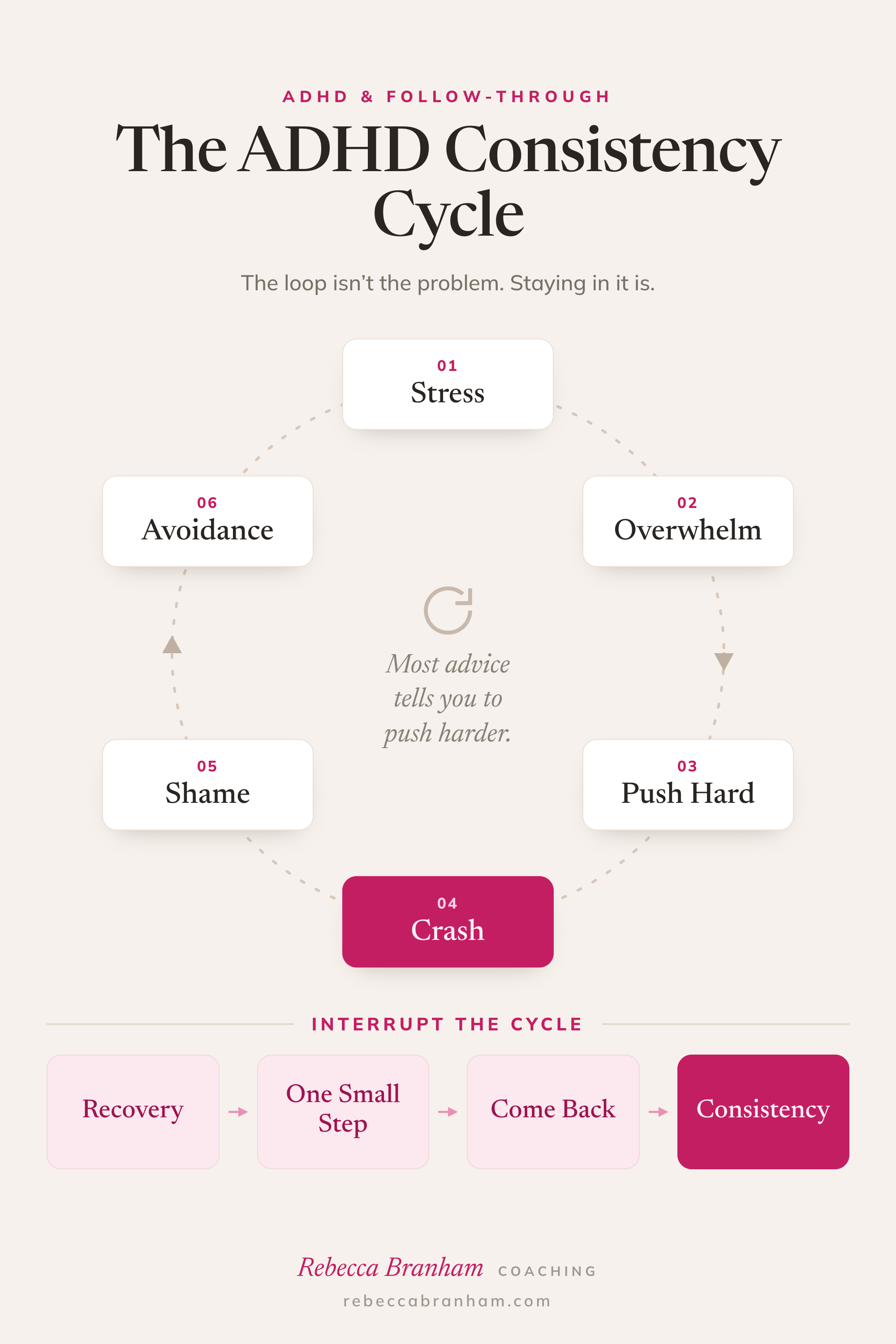
Most productivity advice is rooted in pushing harder. But for women with ADHD, it's not about doing more; it's about reducing how long you stay stuck when you hit resistance.
That's where emotional safety, nervous system tools, and gentle structure come in.
That's also why trying harder rarely solves the problem. If your nervous system already feels overwhelmed, adding more pressure usually creates more resistance, not more progress. The goal isn't to force yourself through it. The goal is to create enough safety that taking the next step feels possible again.
Because the real measure of consistency isn't how often you show up without interruption. It's how you support yourself when you fall off so you can come back faster, without shame.
The opposite of inconsistency isn't perfection. It's recovery.
For most women with ADHD, the cycle looks something like this:
You're Not Inconsistent. You're Overwhelmed.
Most advice on consistency is built on willpower, discipline, and unrealistic routines that work against your brain, not with it.
Especially if you're neurodivergent, following a rigid structure often creates more pressure than peace. And the minute you fall off, the shame spiral kicks in:
"Why can't I just stick with it?"
"Maybe I'm not cut out for this."
"I'll start again Monday."
That cycle isn't broken by a better planner or a stronger morning routine. It's broken when you create structure that feels emotionally safe.
Your brain isn't resisting productivity. It's protecting you from what it believes is a threat.
When you build systems that honor your capacity, your needs, and your nervous system, you naturally show up more often with less resistance. You're no longer forcing consistency. You're building a way of living that you can actually sustain.
Once you understand what's really happening, it becomes clear why most advice falls flat.
Why Traditional Productivity Advice Doesn't Work
Most productivity advice assumes your biggest problem is motivation, but motivation usually isn't the problem.
If you're reading this, chances are you already care. You want to follow through. You want to keep promises to yourself. You don't enjoy falling behind.
The problem is that most advice skips over everything that happens between deciding to do something and actually doing it. That's where ADHD, executive dysfunction, emotional regulation, and shame all show up.
Every unfinished task starts to feel like evidence that something is wrong with you instead of evidence that your current system isn't working. That's a very different problem, and it needs a very different solution.
If consistency isn't the goal, then what should you focus on instead?
What Nervous System Safety Looks Like
When I talk about creating "safety," I'm not talking about making life easier or avoiding hard things.
Life is still going to throw curveballs. You'll still have stressful weeks, unexpected interruptions, and days when your brain just isn't cooperating.
Safety means creating a system that still works when those things happen.
Because if your system only works when you're motivated, well-rested, and having a great day, it's not really a system. It's wishful thinking.
Here's what nervous system safety actually looks like in everyday life.
Have a Version of Success for Your Hardest Days
Most people only define success by what they can accomplish on a great day.
But life isn't made up entirely of great days.
If your definition of success requires perfect focus, lots of energy, and zero interruptions, you're going to feel like you're failing every time life gets messy.
Instead, create a version of success that still counts when you're tired, overwhelmed, emotionally drained, or running on two hours of sleep.
That's exactly why I teach the Good, Better, Best method inside The Show Up Formula™, where I help women create a version of success that works on every kind of day.
Maybe your Best day looks like finishing a work project, making dinner, working out, and answering every email.
Your Good day might be taking your medication, drinking enough water, and replying to one important message.
Both count.
Because progress isn't measured by how much you accomplished.
It's measured by whether you kept moving in the direction you want to go.
Consistency isn't built on your best days. It's revealed by how you respond to your hardest ones.
Stop Treating Every Setback Like You're Starting Over
One of the biggest lies ADHD tells us is that if we miss a few days, we've ruined everything.
Miss one workout? You might as well quit.
Forget your planner for a week? Clearly the system didn't work.
Skip meal prep?
"I'll start again Monday." But that's not how progress works.
Missing a day, or even a week, doesn't erase everything you've already built.
It simply means life happened.
The goal isn't to avoid falling off track.
The goal is to make coming back feel normal instead of shameful. Every time you come back, you're practicing consistency even if you missed the last five days.
The faster you stop seeing setbacks as failures, the faster you can get moving again.
Build Your Life Around Your Real Energy, Not Your Ideal Energy
It's easy to make plans based on the version of yourself you hope shows up every day.
The version who wakes up energized, stays focused for hours, never gets overwhelmed, and always has plenty of motivation.
But that's not real life.
Your energy changes. Your attention changes. Your capacity changes. Instead of pretending those changes don't exist, build your routines around them.
Maybe your best thinking happens in the morning. Maybe afternoons are better for repetitive tasks. Or maybe after a stressful meeting, your brain needs ten minutes to reset before jumping into the next thing.
None of that makes you inconsistent.
It makes you human.
The more your systems work with your brain instead of against it, the less energy you'll waste trying to force yourself into someone else's routine.
Remove Shame from the Recovery Process
This might be the hardest part.
Because for many women with ADHD, the mistake isn't what hurts the most.
It's everything we say to ourselves afterward.
"I should know better."
"Why can't I ever stay consistent?"
"I was doing so well."
Those thoughts don't motivate you. They make it harder to come back because shame tells your brain that getting started again is unsafe. If trying again feels like risking another failure, your brain will naturally want to avoid it.
Compassion does the opposite.
It creates enough emotional safety to take the next step.
That doesn't mean letting yourself off the hook.
It means recognizing that beating yourself up has never been the thing that helped you move forward.
Consistency Is Built in the Comeback
The moment you stop measuring consistency by how often you show up perfectly and start measuring it by how quickly you come back, everything changes.
You're no longer chasing an impossible streak. You're building resilience. You're teaching yourself that a hard day doesn't have to become a hard month and that one missed habit doesn't have to become abandoning the goal altogether.
That's not lowering the bar.
It's building a floor. Your hardest days don't erase your progress. They reveal whether your system can support a real life.
And when life inevitably knocks you down, it's that floor that keeps you from crashing all the way back to the beginning.
Even with the right system, there's one more myth that keeps so many women stuck.
Stop Waiting to Feel Motivated
One of the biggest myths about consistency is that successful people feel motivated more often.
They don't.
They've learned how to keep showing up even when motivation isn't there.
For women with ADHD, that doesn't mean pushing through exhaustion.
It means making the next step so small your nervous system doesn't see it as a threat.
Sometimes that next step is opening the laptop.
Sometimes it's putting on your shoes.
Sometimes it's writing one sentence.
Tiny actions may not look impressive, but they build something much more important than momentum. They build trust. Every time you keep one small promise to yourself, you teach your brain, "I don't have to start over."
That's the identity you're really trying to build.
The Show Up Formula™
Consistency isn't about never falling off track. It's about making sure the path back is always shorter than the path away.
If you've spent years believing you just needed more discipline, I hope this article gave you something different.
I hope it gave you permission to stop fighting your brain and start working with it.
Because consistency isn't something you earn after you finally get your life together.
It's something you build by learning how to come back again and again.
You don't need another planner or another productivity hack. You need a system that's built for the way your brain actually works. That's exactly why I created The Show Up Formula™.
Inside, I'll teach you the same ADHD-friendly system I use with coaching clients to reduce overwhelm, recover faster after setbacks, and keep moving forward without relying on motivation or shame.
Key Takeaways
- ADHD consistency is built through recovery, not perfection.
- Your nervous system influences your ability to follow through.
- Good, Better, Best gives your brain a version of success for every kind of day.
- Tiny actions rebuild trust faster than waiting for motivation.
- The goal isn't to never fall off. It's learning how to come back.
Frequently Asked Questions
Why is consistency harder for neurodivergent women?
Consistency requires the brain to initiate, sustain, and recover - three functions directly affected by ADHD and nervous system dysregulation. When your internal systems are running in survival mode, the brain prioritizes threat response over task completion. This isn't a discipline problem. It's a neurological one. During periods of stress, the prefrontal cortex, the part of the brain responsible for planning, decision-making, and self-control, becomes less efficient, making follow-through much harder (Arnsten, 2009; McEwen, 1998).
What does nervous system safety have to do with follow-through?
When your nervous system feels unsafe - whether from overwhelm, shame, or unpredictable demands - it shifts into protection mode. In that state, starting tasks feels threatening, decision-making shuts down, and the brain defaults to avoidance. Building nervous system safety means creating conditions where your brain feels regulated enough to try. That's when follow-through becomes possible.
Why can I be consistent for a few days and then suddenly stop?
This is incredibly common with ADHD. Often, you're relying on motivation, urgency, or hyperfocus to carry you forward. Those can create short bursts of productivity, but they aren't sustainable. Once your brain runs out of energy or becomes overwhelmed, it becomes much harder to initiate tasks, make decisions, and keep going. That doesn't mean you've lost all your progress. It means your brain needs a way to recover, not a reason to start over. Learn more about getting back on track after a hard week.
Can people actually become consistent?
Yes, but consistency with ADHD usually looks different than people expect. It isn't about doing everything perfectly every day. It's about creating systems that still work when motivation is low, life gets messy, or your energy changes. The goal isn't to never miss a day. The goal is to make it easier to come back after you do. When you stop measuring consistency by perfection and start measuring it by your ability to recover, consistency becomes much more sustainable.
How do I stay consistent when every day feels different?
One of the biggest mistakes people make is expecting themselves to perform at the same level every day. ADHD brains don't work that way. Sustainable consistency comes from having a flexible plan that adapts to your energy and capacity instead of expecting perfection. That's exactly why I created the Good, Better, Best framework inside The Show Up Formula™.
Is it normal to have intense bursts of productivity followed by crashes?
Yes - and it has a name. Boom-bust cycles are extremely common in ADHD and nervous system dysregulation. The brain hyperfocuses or pushes hard, depletes its resources, and then crashes. The fix isn't to push harder during the burst. It's to build recovery into the system so the crash is shorter and the next burst isn't starting from zero.
How do I stop the shame spiral after falling off track?
The shame spiral is fueled by the gap between what you planned to do and what you actually did. Narrowing that gap starts with lowering the floor - not the ceiling. When Good is genuinely achievable on a hard day, there's less gap to shame yourself about. Regulation tools (naming what's happening, one grounding action, choosing the smallest next step) interrupt the spiral before it deepens.
References
- Barkley, R. A. (2015). Attention-Deficit Hyperactivity Disorder: A Handbook for Diagnosis and Treatment. Guilford Press.
- Volkow, N. D., et al. (2011). Motivation deficit in ADHD is associated with dysfunction of the dopamine reward pathway. Molecular Psychiatry. https://doi.org/10.1038/mp.2011.64
- CHADD. Emotional Dysregulation in Adults with ADHD. https://chadd.org/
- National Institute of Mental Health. Attention-Deficit/Hyperactivity Disorder. https://www.nimh.nih.gov/health/topics/attention-deficit-hyperactivity-disorder-adhd
- Harvard Health Publishing. Emotional Regulation Skills Everyone Can Learn. https://www.health.harvard.edu/mind-and-mood/self-regulation-for-adults-strategies-for-getting-a-handle-on-emotions-and-return-to-yourself
