
ADHD, Hormones, and How to Stop Feeling Like You’re Spiraling Every Month
Aug 06, 2026Some weeks you wake up and something feels different. You're moving through your to-do list. You're present in conversations. You're ahead of things, or at least not drowning in them. You close your laptop at the end of the day and think, okay, maybe I have this handled.
Then a week or two later, you're sitting on your bathroom floor at 9pm wondering what happened to that person.
Your brain is foggy. Every small thing feels like a crisis. You snapped at someone you love over something you can't even fully explain. You meant to send three emails and spent forty-five minutes staring at your inbox instead. You canceled plans because you genuinely did not have one more thing left in you.
And the cruelest part? You can't point to anything that went wrong. Life didn't get harder. You just got worse.
If that cycle sounds familiar, and if it happens on a predictable schedule, your ADHD menstrual cycle may be playing a bigger role than you realize. I want you to hear this before anything else.
You are not backsliding. You are not failing. You are not broken in a new and more complicated way than you previously thought.
The relationship between hormones and ADHD is something many women are never taught, even though it can have a significant impact on daily life.
What's Actually Going On in Your Brain
The short version, and I mean the version that will actually make sense of your life.
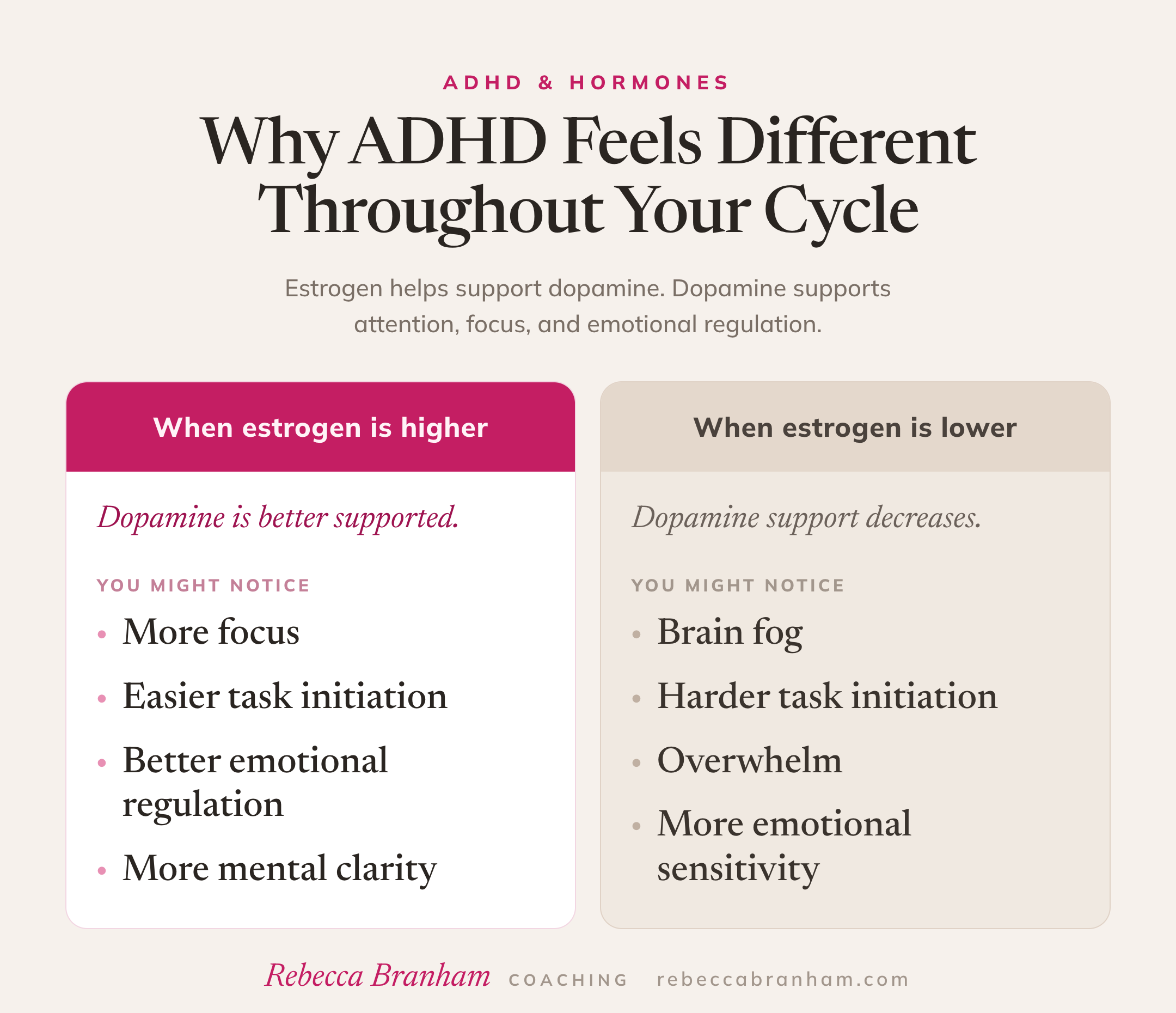
Estrogen and dopamine are linked. When estrogen rises, it boosts dopamine availability, which is the neurotransmitter your ADHD brain already produces less of than average. More estrogen means more dopamine. More dopamine means better focus, more emotional regulation, easier task initiation. The version of you that feels like she has her life together? That's high estrogen.
Progesterone has the opposite effect. When progesterone rises, particularly in the second half of your cycle, it lowers dopamine availability. Your brain, which was already working harder than most to regulate focus and emotion, now has even less of what it needs to do that job.
This is why your ADHD doesn't feel the same every week. Because neurochemically, it isn't. Your symptoms are shifting in a predictable hormonal pattern every single month, and most women with ADHD were never told this is happening.
Here's what that relationship looks like in a simple visual:
Research published in the Journal of Attention Disorders found that women with ADHD report significantly more symptom variability across their menstrual cycle than women without ADHD, with the most severe symptoms in the late luteal phase, the week before menstruation begins.
This isn't PMS. This isn't you being sensitive or inconsistent or difficult. This is a biological pattern that has been playing out in your body every month, probably for years, and you have been blaming yourself for it.
That stops now.
How This Actually Shows Up
Because knowing the science matters less than recognizing yourself in it.
You lose focus halfway through conversations you were engaged in two minutes ago. You avoid tasks you genuinely care about and cannot explain why. You snap at your partner or your kids over something that, on a different week, you would have brushed off completely. You make a decision that would normally take you thirty seconds and it takes two hours and still doesn't feel resolved. Your whole day shuts down because your nervous system hit a wall and you have nothing left to give it.
And then, a few days later, you feel fine. Almost like it didn't happen. Which is its own kind of disorienting, because if you can feel fine now, why couldn't you feel fine then?
Because the chemistry shifted. Not because you became lazy, weak, or less capable.
You are not inconsistent. Your hormones are cycling. And your ADHD brain feels every single fluctuation.
Your Cycle and Your ADHD: What to Actually Expect Each Week
Understanding how your ADHD symptoms change throughout your menstrual cycle can help you stop blaming yourself and start planning with your brain instead of against it.
This is not a rigid schedule. Your cycle is yours, and it may not follow the textbook. But knowing roughly what's happening hormonally each week gives you something more useful than a productivity system. It gives you permission to stop treating every phase of your cycle like it should perform the same.
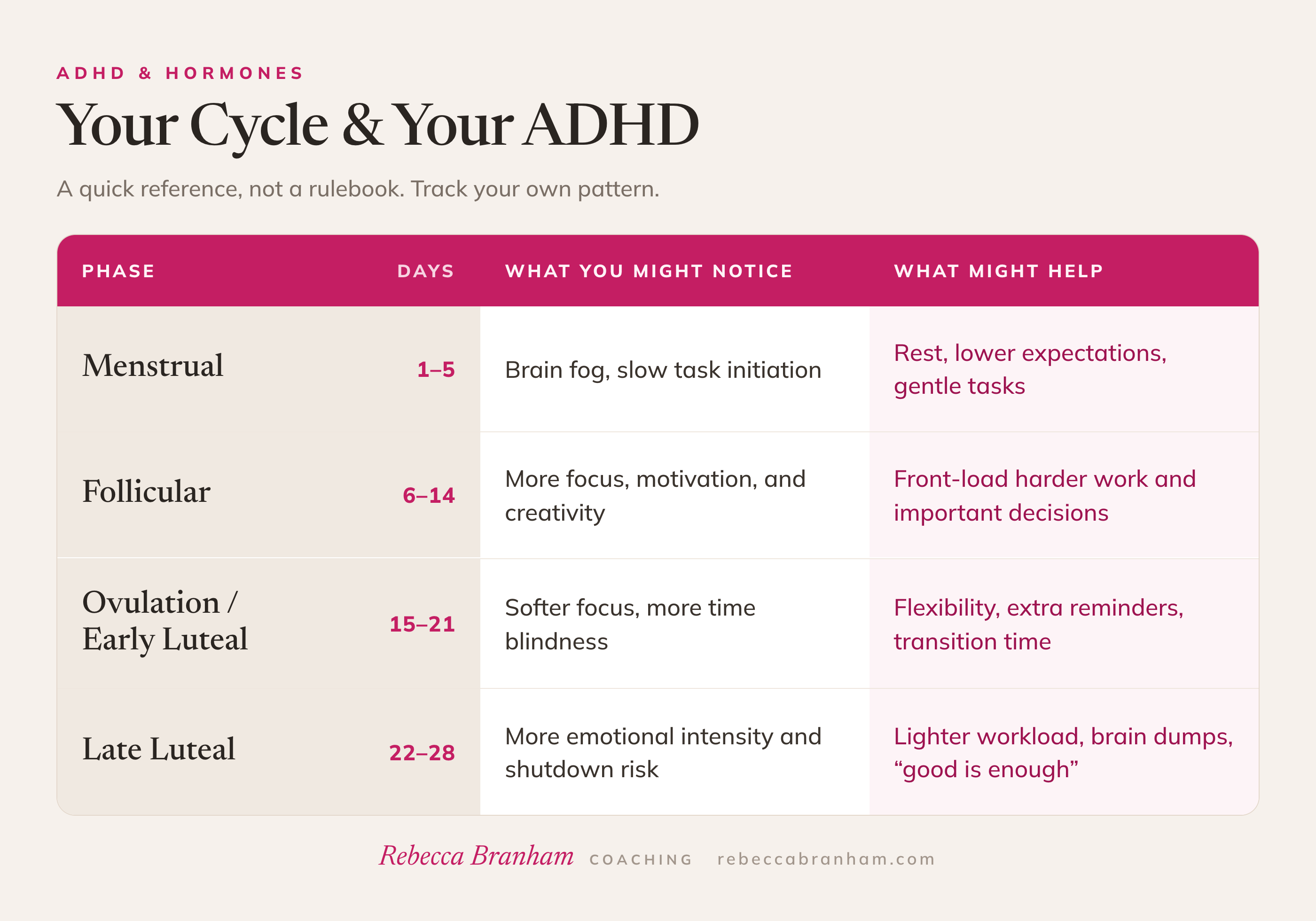
Menstrual Phase (Days 1 to 5)
This is week one of your cycle. Estrogen is low but starting to rise. You might feel foggy, slow, more emotionally tender than usual. Task initiation is harder than it looks from the outside, and from the inside it can feel like pushing through concrete.
This is not the week to schedule your hardest work, your most important conversations, or anything that requires you to be at full cognitive capacity. This is the week for gentler things: rest, water, protein, low-stakes tasks that move you forward without costing you more than you have.
Give yourself explicit permission to lower the bar. Good is genuinely good this week.
Follicular Phase (Days 6 to 14)
This is week two of your cycle. Estrogen is rising, and dopamine rises with it. This is often the week where you think, oh, I actually can do this. Focus is more accessible. Motivation shows up without you having to manufacture it. Creativity feels natural.
Front-load the hard things here. Start the project. Have the conversation you've been putting off. Make the decision. Plan the thing you want to execute later in the month. Your brain is on your side this week, and that window is worth using deliberately.
Ovulation and Early Luteal (Days 15 to 21)
This is week three of your cycle. Estrogen peaks and then starts to drop. Progesterone begins rising. You might notice your focus softening slightly, your emotional sensitivity increasing, your sense of time getting fuzzier than usual.
Time blindness tends to worsen here specifically. Check your calendar more than you think you need to. Build in transition time between tasks. When things don't go as planned, and they may not, practice being a little more flexible with yourself than you would be in week two.
Late Luteal and PMS (Days 22 to 28)
This is week four of your cycle. Estrogen drops sharply. Progesterone is high. Dopamine availability is at its lowest point in your cycle.
This is the week most women with ADHD describe as the one where everything falls apart. For many women, these are the ADHD symptoms before your period that finally make them realize their cycle is affecting their brain, not just their body. Emotional dysregulation, focus and memory dropping off, impulsivity spiking, shutdown becoming a real possibility rather than a dramatic metaphor.
If you can, plan lighter here. This is not the week for launches, high-stakes decisions, or conversations that require you to be regulated and precise. Brain dump everything swirling in your head so your working memory doesn't have to carry it. Double your support, double your kindness to yourself.
And when you're in it, remember what's actually happening. Your dopamine is low. Your nervous system is working harder than it should have to. That's a physiological reality, not a character flaw.
Good is enough this week. Genuinely.
Quick Reference: Your Cycle & Your ADHD
Save this for your next hard week.
A Note on PMDD
If what you just read sounded less like "hard weeks" and more like "genuinely cannot function, genuinely losing my mind, genuinely wondering if I need to be hospitalized," I need you to hear this clearly.
PMDD, Premenstrual Dysphoric Disorder, is significantly more common in women with ADHD than in the general population. It is a diagnosable condition, not extreme PMS, not sensitivity, not something to white-knuckle through with a better morning routine.
If your mood shifts, shutdowns, and emotional spirals in the week before your period feel debilitating rather than just uncomfortable, bring it to your doctor or psychiatrist specifically using the word PMDD. You deserve treatment, not just better coping strategies.
You're Not Backsliding. Your Hormones Are.
Every time you hit a hard week and tell yourself you've lost your progress, that you were doing so well and now you've ruined it again, I want you to come back to this.
Your hormones are playing tug-of-war with your dopamine every month. The version of you who showed up clearly last week is not gone. She is waiting for the chemistry to shift back. And it will.
Awareness is the first tool. You cannot work with a pattern you don't know is there. The next step is learning how to adjust your expectations without abandoning your goals.
The second tool is a system built for fluctuation. Not for the version of you who performs consistently every single day, but for the version who has hard weeks and needs a way back in that doesn't require starting over. A system where Good on a low-dopamine Tuesday still counts, still moves you forward, still means something.
That's what The Show Up Formula™ is built around. A tiered approach to daily planning, Good, Better, Best, that gives you a version of success available on every kind of day, including the ones where your nervous system has nothing left to give.
Explore The Show Up Formula™ →
Key Takeaways
- ADHD symptoms can change throughout your menstrual cycle.
- Estrogen helps support dopamine, which affects attention, focus, and emotional regulation.
- The late luteal phase is often the most challenging week for women with ADHD.
- Tracking your symptoms can help you plan with your brain instead of against it.
- You are not backsliding. Your hormones are cycling.
Frequently Asked Questions
Why does ADHD get worse before my period?
In the week before menstruation, the late luteal phase, estrogen drops sharply while progesterone is at its peak. Because estrogen supports dopamine production, this drop directly reduces the dopamine your ADHD brain already struggles to regulate. The result is more intense symptoms, emotional dysregulation, focus crashes, impulsivity, and shutdown, that typically ease once menstruation begins and estrogen starts rising again.
Can ADHD symptoms change throughout the menstrual cycle?
Yes. Many women with ADHD notice that their symptoms change throughout the month as hormone levels fluctuate. Estrogen helps support dopamine, a neurotransmitter that plays a key role in attention, motivation, emotional regulation, and executive functioning. As estrogen rises and falls during your cycle, you may notice changes in focus, task initiation, memory, emotional sensitivity, and impulsivity. While every woman's experience is different, recognizing these patterns can help you work with your brain instead of blaming yourself when certain weeks feel more difficult.
Can ADHD medication stop working at certain points in my cycle?
Many women with ADHD notice their medication feels less effective during the late luteal phase. This is consistent with the hormonal mechanism. When estrogen drops and dopamine availability decreases, stimulant medications can have a reduced effect. If you notice this pattern consistently, it's worth discussing with your prescribing doctor. Some women benefit from medication adjustments during specific cycle phases.
What is PMDD and how is it connected to ADHD?
PMDD is a severe form of PMS characterized by significant mood disturbance, emotional dysregulation, and functional impairment in the week before menstruation. Research shows women with ADHD are at significantly higher risk for PMDD, likely because both conditions involve dopamine dysregulation. If your premenstrual symptoms feel debilitating rather than just uncomfortable, speak with your doctor about PMDD specifically.
How do I track my ADHD symptoms alongside my cycle?
You don't need a complicated system. A simple daily note covering energy level, focus quality, emotional regulation, and where you are in your cycle, kept over two to three months, is enough to reveal your personal pattern. Apps like Clue or a basic notes log both work well. The goal is pattern recognition, not perfection.
Is cycle-based planning actually realistic for ADHD brains?
Yes, with the right approach. Rigid cycle syncing, where you try to plan every single day around your hormones, can create more pressure than it relieves. A more sustainable version is knowing your rough phases and using that awareness to lower the bar during harder weeks and front-load important things during stronger ones. You're giving yourself permission to have easier weeks without calling it failure. That's not a workaround. That's working with your actual brain.
References
Robison, R. J., et al. (2008). Hormone fluctuation and ADHD symptom severity in women. Journal of Attention Disorders. https://doi.org/10.1177/1087054708322006
Epperson, C. N., et al. (2014). Premenstrual dysphoric disorder and ADHD: a review of the evidence. CNS Spectrums.
Haimov-Kochman, R., & Berger, I. (2014). Cognitive functions of regularly cycling women may differ throughout the month, depending on sex hormone status. Frontiers in Human Neuroscience. https://doi.org/10.3389/fnhum.2014.00191
CHADD. Women and Girls with ADHD. https://chadd.org/
National Institute of Mental Health. Premenstrual Dysphoric Disorder. https://www.nimh.nih.gov/health/publications/premenstrual-dysphoric-disorder
