
How to Get Back on Track After a Hard Week (Without Starting Over)
Jul 29, 2026You closed your laptop on Friday and told yourself you'd deal with it Monday.
Monday came. You made a list. You felt briefly optimistic. By Wednesday you were drowning again, and by Thursday you were already mentally filing the week under lost cause and promising yourself that next week would be different.
If that's been your cycle for longer than you'd like to admit, I need you to hear this before we go any further.
You don't have a discipline problem.
And if you have ADHD, one hard week can quickly turn into two, not because you aren't trying, but because your brain mistakes getting back on track with ADHD for "starting completely over. Executive functioning challenges, like task initiation, planning, and prioritization, are core features of ADHD, which is one reason recovering from a hard week can feel so much harder than it looks.
Why your ADHD brain jumps straight to "start over"
Here's what's actually happening when a hard week tips into an ADHD overwhelm spiral.
Your brain hits a certain level of overwhelm and it does something that feels logical but is quietly making everything worse. It simplifies. When there's too much to process, too many dropped balls, too many things you said you'd do and didn't, the brain collapses it all into one enormous, formless feeling of behind.
And the only solution it can compute for behind is: start fresh. Wipe the slate. Begin again Monday.
It's not laziness. It's not weakness. It's actually your nervous system trying to protect you by making the problem smaller. The problem is that "starting over Monday" doesn't solve anything. It just gives your brain permission to avoid today.
Whether you're coming back from a hard week, ADHD burnout, or a season of overwhelm, the way you recover matters far more than how perfectly you start over.
All-or-nothing thinking sounds like:
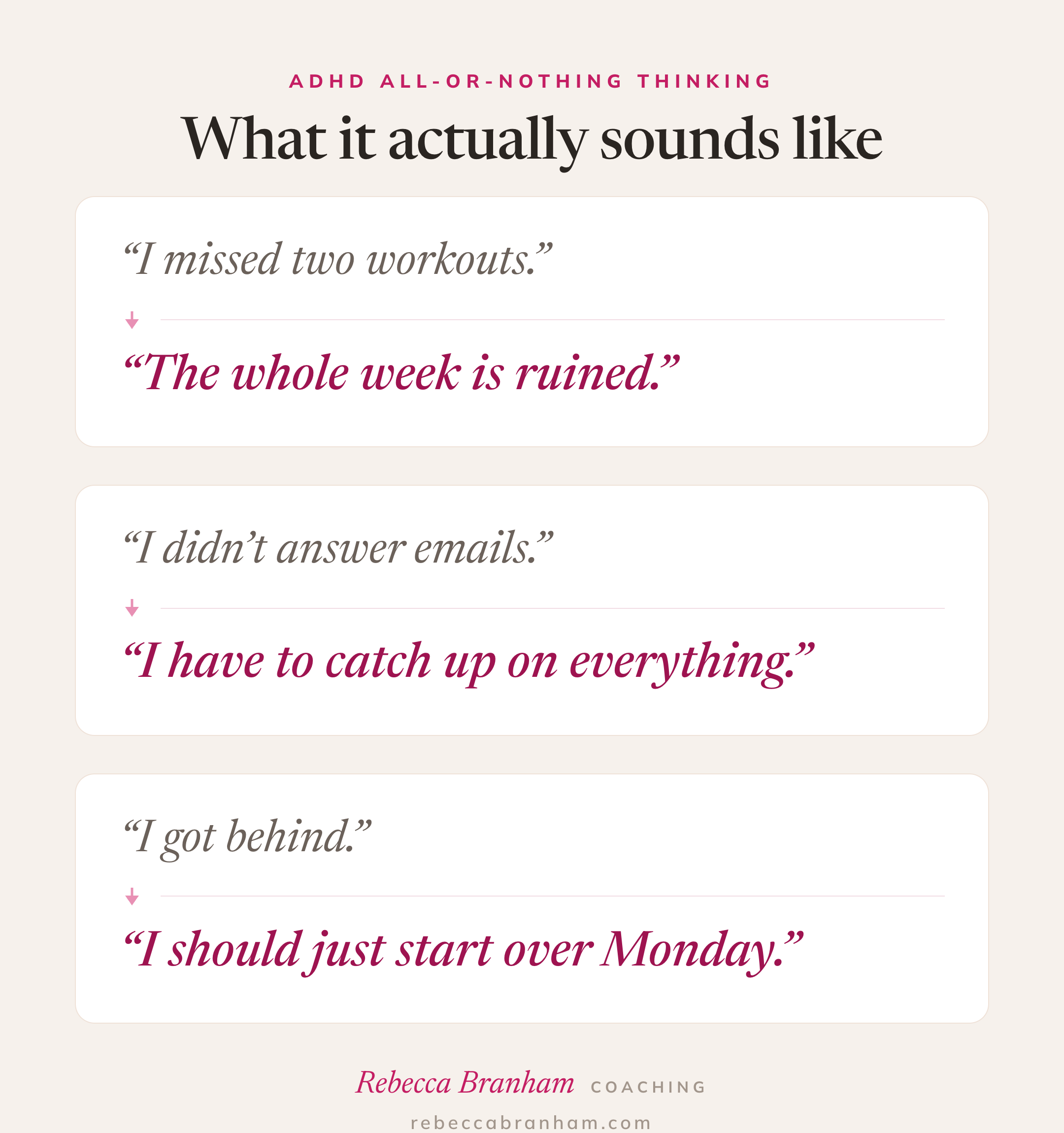
Sound familiar? That's perfectionism wearing the costume of productivity. And it keeps you stuck in the same loop every single time, because the bar for "starting" is so high that you can never quite clear it.
Maybe laundry piled up.
You missed two workouts.
You haven't answered emails in four days.
The dishes are still sitting in the sink, and your kitchen looks like a tornado hit it.
Now your brain has decided you need to fix all of it before you're allowed to move forward.
Add ADHD into that mix, or burnout, or a week where your kids were sick and work exploded at the same time, and your executive function is already working overtime just to get you out of bed. Asking it to also figure out where to begin on a mountain of undone things is asking too much.
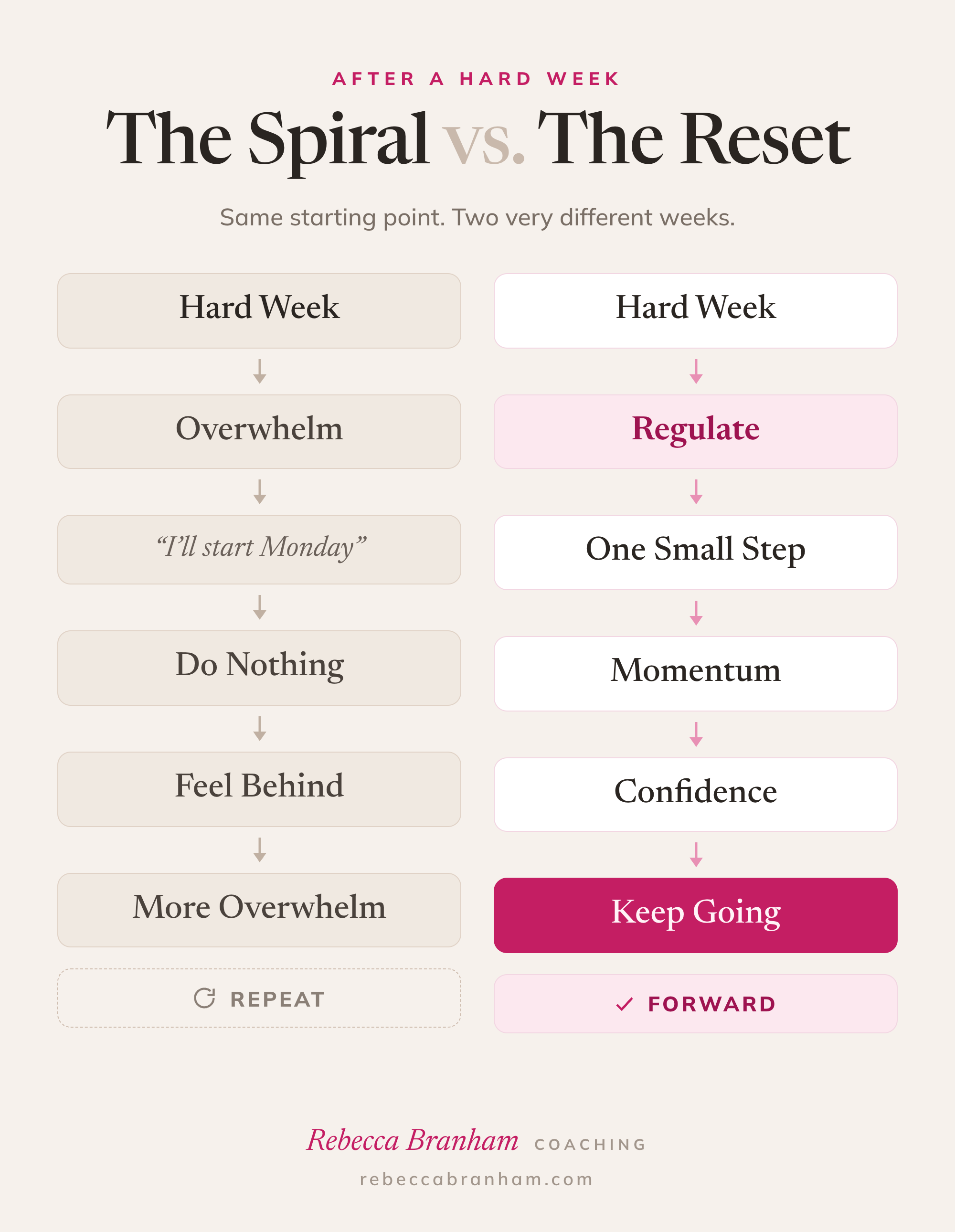
The solution isn't a better to-do list. It's learning how to regulate first so you can ask a better question.
If this cycle feels familiar, it usually looks something like this:
Step one: Stop trying to earn your way back.
I know. Every instinct you have is screaming at you to catch up. Your brain has decided that catching up equals safety, and that once you're caught up you'll finally feel okay.
But catching up isn't how you move forward. It's how you exhaust yourself trying to drag the past into the present.
Here's what actually happens when you try to catch up after a hard week. You make a list of everything you dropped. You try to do all of it immediately. By Tuesday you've done maybe a third of it and the rest has migrated to Wednesday, and by Thursday you're in the same spiral you were in the week before, except now you also feel like you failed at catching up.
The week you had is over. You cannot go back and un-have it. What you can do is decide where you're going from here, and that's a very different starting point.
Stop measuring what you owe the past week. Start asking what the next 24 hours needs.
Before you rebuild anything, regulate first
This is the part nobody tells you, and it's the part that changes everything.
When you're in that overwhelmed, behind, I-can't-even-look-at-my-inbox state, your brain and body are responding to stress. During that state, it's much harder for the part of your brain responsible for planning, prioritizing, and decision-making to do its job. That's why even simple decisions can suddenly feel impossible. It can feel like you can't figure out where to start, even when you know exactly what needs to get done.
So before you try to figure out what to do first, your only job is to make your brain capable of making a decision.
That looks embarrassingly simple. Things like:
Drink a full glass of water. Eat something with protein. Take a shower. Walk outside for ten minutes, even just to the end of the street and back. Sit somewhere quiet for five minutes without your phone. Text one person who makes you feel normal. Take five slow breaths where the exhale is longer than the inhale.
None of these fix the week. None of them clear your inbox or finish the proposal or get you back on track. What they do is move your nervous system out of threat response and back into a place where thinking is possible.
You cannot organize your way out of overwhelm. You have to feel your way through it first.
This isn't woo. This is physiology. During periods of stress, your brain prioritizes survival over higher-order thinking, making it harder for your prefrontal cortex (the part responsible for planning, decision-making, and self-control) to do its job. That's why even simple decisions can suddenly feel impossible.
Regulate first. Rebuild second. Every time.
Then ask yourself one question
Not: How do I catch up on everything?
Not: What do I need to do today?
Instead, ask yourself:
What's my version of showing up today?
It's the same framework I teach inside The Show Up Formula™ because ADHD brains need a version of success that's available on every kind of day, not just the good ones.
Then ask yourself:
What's Good?
What's Better?
What's Best?
Good is the version of today that moves you forward without requiring you to be at your best.
Good is realistic for a person who just had a hard week and is running on something close to empty.
Maybe Good is drinking water and going through your inbox without responding to everything.
Maybe Better is actually responding to the three most important emails.
Maybe Best is doing that plus finishing the one task that's been sitting there the longest.
Here's what changes when you think this way. You stop asking how to do everything and start asking what's actually possible for the version of you that exists right now, today, with the energy you actually have. Not the energy you wish you had. Not the energy you had last Tuesday. The energy that's here.
Every option on that list moves you forward. Good still counts. Good is still progress. Good does not get to be dismissed as not enough, because enough is relative to where you're starting from, and you're starting from a hard week, not from a perfect reset.
Progress isn't built by never falling behind
It's built by knowing how to come back.
This is the thing I want you to actually remember, because your brain is going to try to talk you out of it every single time.
Getting back on track with ADHD doesn't mean you never miss a week. It means when you miss a week, you know what to do next. That's the skill. Not the not-falling. The coming-back.
Every time you regulate instead of push through, every time you choose Good over nothing, every time you stop waiting for the perfect reset and just take the next small step, you are building something real. You are teaching your brain a new story about what happens when things go sideways.
The story changes from: I fall behind and then I give up.
To: I fall behind and then I come back.
That's not a small thing. That's the whole thing.
You didn't lose your progress. You had a hard week.
Those are different things, and it matters that you know the difference.
You don't need a fresh start.
You just need your next step.
The Show Up Formula™ is built around one simple idea: ADHD brains need a version of success that's available on every kind of day, not just the good ones. Instead of waiting until you have more motivation, more energy, or a "fresh start," you'll learn how to keep moving forward with the brain you have today.
Frequently Asked Questions
Why does ADHD all-or-nothing thinking happen?
All-or-nothing thinking is a product of how ADHD affects the brain's ability to hold nuance under stress. When executive function is taxed, the brain simplifies, and simplification means collapsing a complicated situation into a binary. Either everything is fine or everything is ruined. Either you start fresh Monday or nothing counts. This isn't a character flaw. It's a cognitive pattern that gets worse under overwhelm and better with regulation.
What does it mean to regulate before you rebuild?
Regulating before you rebuild means addressing your nervous system state before trying to make decisions or take action. When you're overwhelmed, your brain is in threat response, and threat response shunts resources away from the prefrontal cortex, the part responsible for planning and starting tasks. Simple physical actions (drinking water, moving your body, slow breathing) shift your nervous system out of survival mode so thinking becomes possible again.
What is the Good, Better, Best framework for ADHD?
Good, Better, Best is a tiered approach to daily planning that gives you a version of success no matter what kind of day you're having. Good is the minimum that still counts, the smallest action that moves you forward. Better adds one layer. Best is the full version. The key is that all three options are defined in advance, so on a hard day your brain isn't deciding what counts as enough. It already knows.
How do I stop the cycle of starting over every week?
The cycle of starting over is usually driven by a bar for "starting" that's too high for hard days. When the only acceptable version of showing up is the full version, any deviation becomes a reason to wait for Monday. The fix is lowering the floor, not the ceiling. Define what Good looks like for a genuinely hard day, and make that your target when you're running on empty. Good still counts. Good is still forward.
Is getting behind a sign of executive dysfunction?
Falling behind periodically is normal. But if getting behind consistently triggers a spiral that makes it harder to restart, if the gap between falling off and getting back on grows wider over time, that's often executive dysfunction at play. The ADHD brain struggles with task initiation, especially when there's a backlog of undone things. The solution isn't more discipline. It's a lower-friction re-entry point and a nervous system that feels safe enough to try.
Can you get back on track after ADHD burnout?
Yes but getting back on track after ADHD burnout usually doesn’t start with pushing yourself harder or trying to catch up on everything at once. Burnout can leave your brain with less capacity for planning, starting tasks, making decisions, and handling everyday demands. That means the usual advice to “just get organized” can make you feel even more behind.
Start by lowering the pressure and choosing the smallest version of progress that still counts. Regulate first, decide what matters in the next 24 hours, and let one doable step be enough. You do not need to return to your full routine overnight. The goal is not to prove that you can do everything again. It is to rebuild trust with yourself by showing your brain that you can come back without starting over.
References
Arnsten, A. F. T. (2009). Stress signalling pathways that impair prefrontal cortex structure and function. Nature Reviews Neuroscience, 10(6), 410–422.
American Psychiatric Association. Diagnostic and Statistical Manual of Mental Disorders (5th ed., text rev.; DSM-5-TR). American Psychiatric Association Publishing, 2022.
Barkley RA. Executive Functions: What They Are, How They Work, and Why They Evolved. Guilford Press.
McEwen, B. S. (1998). Protective and damaging effects of stress mediators. New England Journal of Medicine, 338(3), 171–179. https://doi.org/10.1056/NEJM199801153380307
